Tuesday, October 13, 2015

String Theory

Particles as Strings as tiny vibrating strands of energy-strings

Strings are identified as having a mass and charge as well as wavelength and frequency.

Scaled to the universe from Earth, the strings are only as big as a tree.

Extra Dimensions of Space

  • To allow for variety of properties particles and forces need to be vibrating in more than three dimensions.
Why Strings?
  • Unification Theories
  • Strings smooth out jittery structures and can work in both realms 
M-Theory 
  • Strings can stretch into membranes (d-branes)
  • with enough energy, a d-brane can be as large as a universe!
  • The universe may be a d-brane floating in a higher dimension

News: Water Found on Mars

The National Aeronautics and Space Administration (NASA) has officially announced the existence of water on The Red Planet as of September 28, 2015. A few years back this had merely been speculated, however a recent reconnaissance of the planet as well as sand samples on-board the Curiosity rover have provided firm evidence of its existence. According to images produced by high powered spectrometers, the water contains extremely high concentrations of salts, and a mix of chlorates and perchlorates. This concoction is known to have a low freezing point, therefore can remain in a liquid state during Mars' summer with temperatures above -10 degrees Fahrenheit (F).  During winter on Mars when temperatures reach as low as -195 degrees F, the water freezes into pockets of ice like the glaziers that are believed to remain under the planet's surface.

This discovery goes beyond the excitement of the water. NASA's Jim Green says that "If you look at Earth, water is an essential ingredient. Wherever we find water, we find life." This theory is becoming widely embraced and recently the assumption has been made that because the water remains a sustainable liquid during the summers of Mars, that organic life can exist.


Though comical, this video explains many of the concepts of this new discovery and what they mean for humankind.

Monday, September 28, 2015

Crash Course in Optical Telescopes

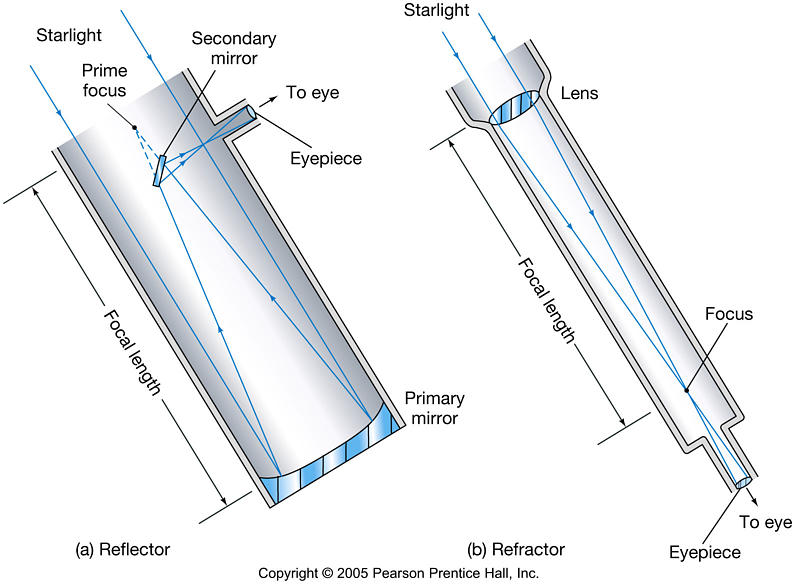
Refraction
·         Forms an image using a lens
·         Light converges to from an image at the focus or focal point
·         Telescope use an objective lens to form a primary image
·         There are major limitations:
o    The scope has to be long and hold a large/heavy lens
o    Correct shape of the lens is crucial and must be perfect at all times
o    The support of the lens is on the edge of lens and can cause it to sag
o    Lenses suffer from CHROMATIC ABERRATION
§  Refraction is dispersive
§  Chromatic Aberration occurs when the dispersive nature of refraction blurs the original image
·         Would be okay for close objects, but not ideal from distance viewing
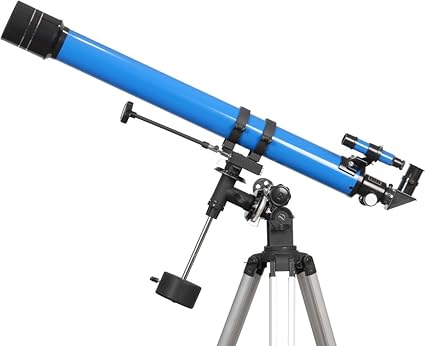
Refracting Telescope
Reflecting
·         Uses a series of mirrors to transmit image to a focal point
·         Law of Reflection: Angle of incidence is equal to the angle of reflection
·         Must be CONCAVE mirrors
o    Receives light from range view
·         Telescope uses a primary mirror to form primary image
o    Kind of like WYSIWYG
·         Advantages of using this scope
o    Use of greater diameter which means more light can be collected
§  More light means more vivid, detailed image
o    One perfect reflecting surface
o    Supported anywhere behind the mirror
o    NO Chromatic Aberration
Diffraction
·         The bending of light around corners of edges
·         Longer wavelengths of light bend more than shorter wavelengths which results in issues for larger diffracting models
o    Splits light into its component wavelengths (the color spectrum)
o    Causes heavy dispersion

Tuesday, September 22, 2015

The Milky Way

If you’ve ever looked up at the night sky to see a clouded 
stripe run from one end of your observable horizon to the other, you are looking into the Milky Way galaxy. This spiral formation is your galactic home.

Milky Way Galaxy spiral arms and SMBH

Leading theories about the center of our average galaxy suggest that there exists a supermassive black-hole now named Sagittarius A shaped like a football. From the center we have drawn proof of four separate arms branching outward. The arms of the Milky Way consist of both population one and population two stars. Population one stars are blue in color because they are a younger, cooler formation. These stars are found along the inside of each arm and are a part of open cluster constructions. Population two stars are older and more red shifted in color. These round stars are found in globular clusters and are too hot to form new stars (void of star-forming material).


The Milky Way consists of approximately 200-400 billion stars across a one hundred thousand light-year diameter and six thousand light-year width. Our solar system is believed to be towards the end of a spiral arm that leaves us about 28 thousand light-years away from the center.
You are here Milky Way Galaxy

Pushing Our Bodies and Our Minds

TIME magazine recently published an article on September 15th covering a Twin Study done on the International Space Station (ISS). The study reports the effects of extended periods of space travel on the mind and body of a cosmonaut. Nobody knows these effects greater than astronaut Gennady Padalka, who is briefly described in the article as the new record holder for most days spend away from Earth878 days over 5 missions!
Gennady Padalka
Check out the full article at 
http://time.com/4034666/space-body-mind/

Monday, September 21, 2015

Exploring Exoplanets

Exoplanets are planets that are beyond our solar system. Most of the exoplanets NASA is interested in are Earth sized and orbiting a sun-like star in the habitable zone, though the first few confirmed exoplanets were actually Jupiter sized. The habitable zone is the range of distance from the planet to its parent star where life is possible- not too close, and not too far. 

The exoplanets orbiting a sun-like star are the best candidates for becoming definitive planets because the magnetic field of these stars closely resemble the magnetic field of the sun which is strong enough to form a planet. More than 1,000 confirmed exoplanets have been discovered by the Kepler Space Telescope which reached orbit in 2009 and searched for these habitable planets for four years. It discovered these exoplanets by using the transit method which records how much a star's light dims when a planet passes in front of it. This helps determine whether the planet has the exoplanet qualities by showing us how big and how close to its planet star it is. The method used when the first Jupiter sized exoplanets were discovered is the radial velocity technique which detects how much a star "wobbles" when its planet orbits- the closer the planet is to the star, the more the star seems to wobble. Kepler has discovered a variety of planets from gas giants and terrestrial planets, to super-Earths which are planets between the size of Earth and Neptune and are also in the habitable zone. 

Monday, September 14, 2015

Hubble Space Telescope

The Hubble Telescope, named after Edwin Hubble, launched into low-Earth orbit in 1990, is indisputably one of the greatest technological advancements of our time. Without this 2.4 meter mirror working tirelessly every hour of every day, astronomers wouldn't be nearly as far along. Most famous for its ground breaking photo, Hubble Deep Field. Within the first week of its orbit, the telescope was able to reveal over 10,000 galaxies using long exposure through the humble reflector mirror. Today it has helped uncover over 10 billion galaxies in the visible universe as well as aided it providing evidence of the origins of the universe. It also has allowed scientist to find that the universe is ever expanding faster and faster and can determine the exact rate of expansion over a series of digital data it constantly collects. Being that it is the only telescope to be serviced in space by astronauts, the Hubble Space Telescope is one of the greatest assets that our soul-searching species owns. 

Hubble Deep Field

For more information and a better learning experience on the Hubble program as well as some interactive modules visit http://hubblesite.org/.